The CATCR initiative
A Critical Health Challenge
The Unmet Need
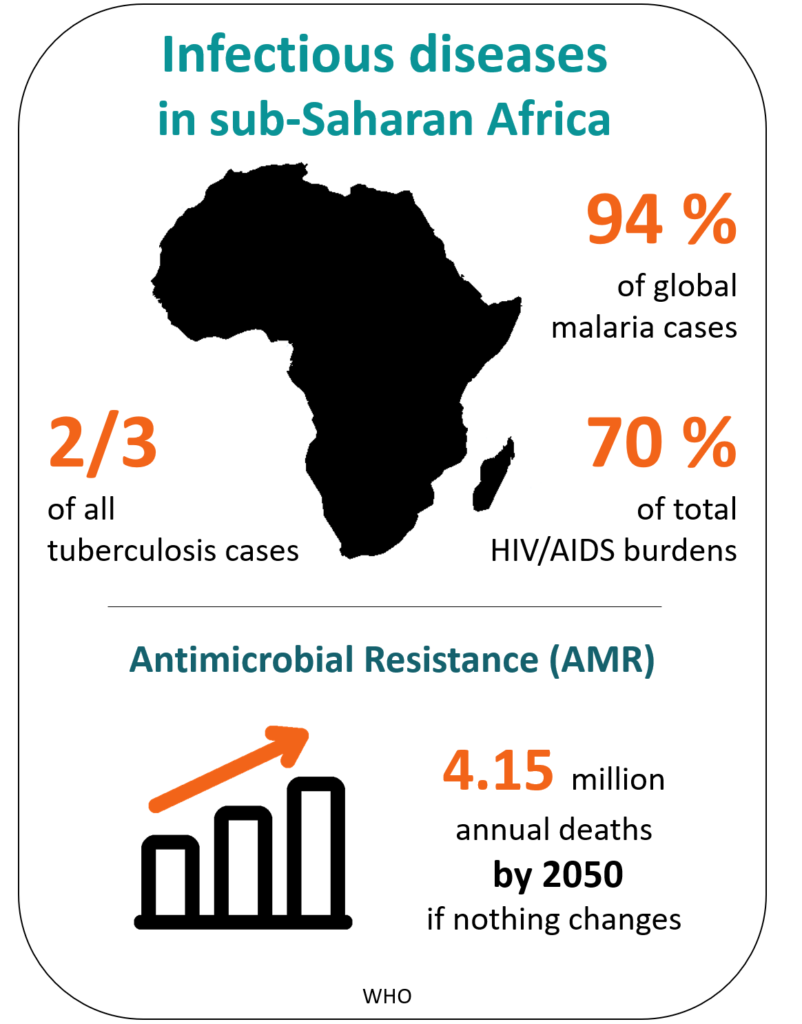
Sub-Saharan Africa is at the epicentre of the world’s most severe infectious diseases, bearing over 90% of global malaria cases, approximately 70% of the total HIV/AIDS burden, and two-thirds of all tuberculosis cases.
Compounding this, the escalating surge of antimicrobial resistance (AMR) threatens to reverse hard-won gains and destabilize healthcare systems.
The World Health Organization warns that by 2050, AMR could cause up to 10 million deaths annually if left uncontrolled, with 4.15 million lives projected to be lost to antibiotic-resistant pathogens in sub-Saharan Africa over the next 30 years.
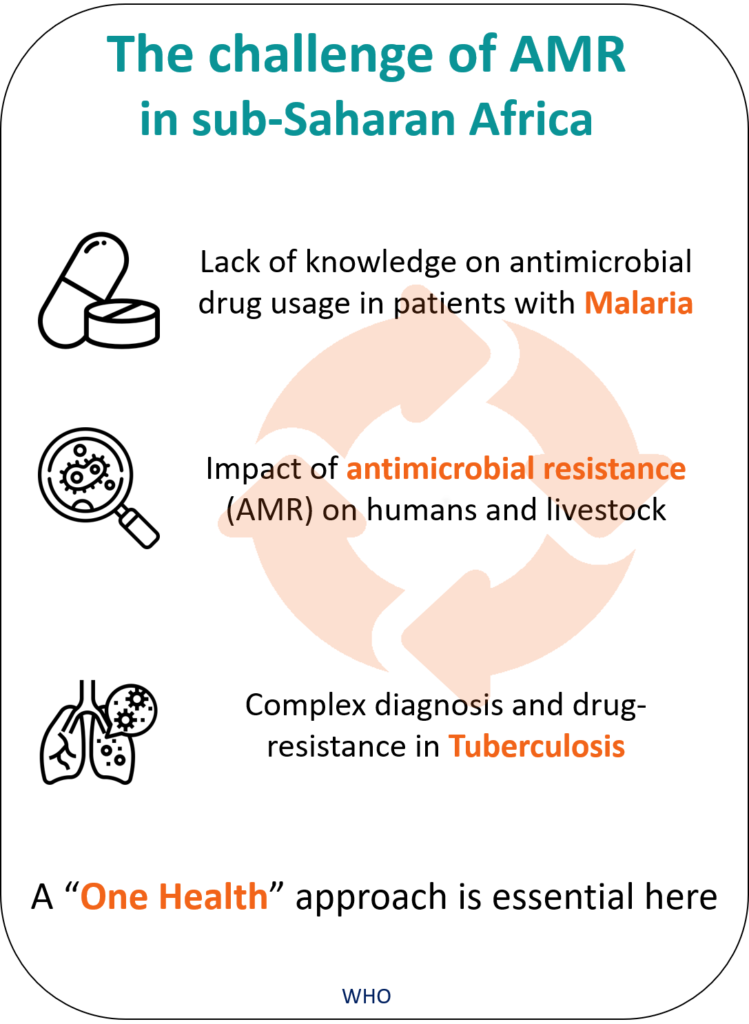
The challenge of AMR in Africa is multifaceted, fuelled by current knowledge gaps including:
- Lack of knowledge on antimicrobial drug usage trends in patients with Malaria, crucial for promoting responsible prescription and utilization.
- Insufficient understanding of the causal link between prevalence rates and influencing factors of carbapenemase-producing Enterobacteria (CPE) and AMR in humans and livestock. A “One Health” approach is critical here.
- Unclear status of tuberculosis (TB) and drug-resistant TB due to substantial gaps in diagnosis and surveillance. An alarming 70% of drug-resistant TB cases remain undiagnosed.
The interconnectedness of our world means a drug-resistant strain emerging in Africa can quickly spread globally.
Addressing these gaps demands a strong network of local researchers and healthcare professionals rooted in Central Africa, who deeply understand local communities, healthcare practices, and disease patterns. However, Africa faces a severe deficit in trained health researchers due to insufficient adapted training, limited post-doctoral support, inadequate research networks, and lack of mentorship.
Our Solution
Antimicrobial resistance (AMR) is escalating across Africa, threatening public health and undermining treatment efforts. In response, the CATCR consortium is launching a bold initiative to build a comprehensive training and research network across Cameroon, the Democratic Republic of Congo, Gabon, and the Republic of Congo.
Our Missions
Excellence
Scientific rigor and integrity form the foundation for a healthier, more resilient future in Central Africa.
Inclusivity
Empowering the next generation of health professionals and researchers, promoting gender equity is central to building a diverse scientific community.
Collaboration
Bringing together researchers, healthcare professionals, and local communities to build a strong, interconnected network that fosters knowledge-sharing and resource exchange.
Innovation
Modern methods and collaborative research drive bold solutions to today’s health challenges and lay the groundwork for addressing future endemic threats.
Our Objectives
Comprehensive Training Programme
Develop a multifaceted training program to enhance the skills and knowledge of health workers and researchers in Central Africa.
Antimicrobial Usage Trends and Resistance Mapping
Understand the trend of antimicrobial usage and map molecular markers of resistance to artemisinin correlated with clinical findings.
Fellowship Programme
Develop a fellowship program that recruits, trains, retains, and evaluates early and mid-career scientists in Central Africa to strengthen research capacity.
AMR Prevalence in Humans and Livestock
Investigate AMR prevalence in humans and livestock, focusing on carbapenemase-producing Enterobacterales (CPE).
Project Findings Dissemination
Efficiently disseminate project findings, targeting researchers, healthcare professionals, patients, citizens, and regulatory authorities.
Drug-Resistant Tuberculosis Evaluation
Evaluate the prevalence, molecular characteristics, and pharmacodynamic relationships of multidrug-resistant tuberculosis.
Developped Network
A part of CANTAM projects
Founded in 2008, the Central Africa Clinical Research Network (CANTAM) builds world-class clinical research capacity across the region. Through the generation of high-quality epidemiological data, the training of skilled researchers—including a strong focus on female scientists—and the development of accredited research infrastructure, CANTAM has transformed the regional research landscape. This strengthened foundation has made it possible to launch the CATCR project, with the full support of leading partners from Zambia, Germany, the United Kingdom, France, and the Netherlands.
Key Partnerships
Collaboration with international institutions to enrich research.
A part of EDCTP3 programm
The Global Health EDCTP3 Joint Undertaking is a major EU-backed funding platform (2021–2031, ~€1.86 billion) supporting clinical research, capacity building, and emergency response to combat poverty-related and neglected infectious diseases in sub-Saharan Africa. It drives multi-phase clinical trials, fosters African and European scientific partnerships, and strengthens regional health research systems to improve epidemic preparedness and public health impact.
Key Programm
Supporting advanced training, mentorship, and clinical fellowships. Strengthen research capacity in Central Africa.
Involved in PACE-UP programm
PACE‑UP (PAN ASEAN Coalition for Epidemic and Outbreak Preparedness) is a global network of 28 partner institutions across Europe, Asia, and Africa working together to strengthen epidemic preparedness and response. Through collaborative research, capacity building, and evidence‑based policy support, PACE‑UP enhances global health security while actively involving African institutions. Their programs create valuable opportunities for African researchers—especially early‑career scientists—by providing training, mentorship, and access to international research collaborations.
Key Programm
Strengthening epidemic preparedness, multinational research collaboration, training & capacity buildin, and Policy support & knowledge exchange
Our partners

The Congolese Foundation for Medical Research (FCRM) is an independent biomedical research organization in the Republic of Congo, committed to excellence, transparency, and capacity building. It conducts epidemiological and clinical studies on major public health issues (such as malaria, HIV/AIDS, tuberculosis), operates a modern medical consultation and laboratory service (CCLAM) in Brazzaville, and hosts specialized research groups focused on infectious disease dynamics, molecular epidemiology, antimicrobial resistance, and socio-cultural determinants of health.

The University of Kinshasa (UNIKIN) is the Democratic Republic of Congo’s flagship public university—dating back to 1954—focused on providing high-level education, engaging in research, and serving the nation with a broad range of academic faculties and decentralized institutions (e.g., clinics, museums, library). It promotes academic excellence, innovation, and socio-economic development through transdisciplinary research capacities, strategic partnerships, and institutional rejuvenation efforts.
The University of Yaoundé I (UYI) is a leading public university in Cameroon, established in 1993 following the split of the original University of Yaoundé, and is renowned for its excellence in teaching, scientific research, and technological innovation.
UYI offers a wide range of academic programs—from fundamental sciences, medicine, and engineering to humanities and education—supported by modern infrastructure, research laboratories, doctoral schools, and strong international partnerships.

The Centre de Recherches Médicales de Lambaréné (CERMEL) is a leading independent research and training center in Lambaréné, Gabon, conducting applied clinical trials (notably antimalarial drugs and vaccines), epidemiological and fundamental research in immunology, molecular biology, tuberculosis, and parasitic and viral infections. It serves as a regional reference hub for high-quality biomedical research and policy-making, supported by international partnerships and a robust quality assurance Framework.

The University of Amsterdam (UvA), founded in 1632, is a leading public research university and a top-ranked institution globally, excelling across disciplines from humanities and social sciences to medicine and data science, with approximately 41,000 students, 6,000 staff, and a strong international orientation through interdisciplinary research and innovation.
Committed to inclusive excellence and societal impact, UvA fosters open, critical learning, invests in digital transformation and infrastructure, and collaborates with regional and global partners to drive sustainable solutions to complex challenges.

The Institute for Tropical Medicine, Travel Medicine, and Human Parasitology (ITM) at the University Hospital Tübingen serves as Baden-Württemberg’s competence center for tropical medicine—offering outpatient and inpatient clinical services, specialized travel and tropical disease consultations, and applied laboratory diagnostics. It leads research and teaching in infectious and parasitic diseases (notably malaria, schistosomiasis, tuberculosis, viral hepatitis, Ebola, filariasis), coordinates clinical trials (including drug and vaccine studies), and shapes global health initiatives in collaboration with partners like the German Center for Infection Research and the Comprehensive Infectious Disease Center.

The University College London (UCL), founded in 1826 in the heart of London, is a globally top-ranked multidisciplinary research university housing around 51,000 students and more than 16,000 staff across over 150 nations. Guided by its long-term “UCL 2034” vision and the Strategic Plan 2022–27, UCL strives to be “London’s Global University”—championing inclusive education, radical and critical thinking, integrated research and innovation, and delivering societal impact locally and globally. It consistently leads in research power (notably in medicine, health, and social sciences), contributes around £10 billion annually to the UK economy, and ranks first in the UK for sustainability in the QS rankings.

The Institut de Recherche pour le Développement (IRD) is a French public scientific and technological institution, under the joint supervision of the Ministry of Higher Education and Research and the Ministry of Foreign Affairs. Since 1944, it has partnered equitably with countries in the intertropical and Mediterranean regions—especially in the Global South—to conduct interdisciplinary, sustainable development research, strengthen local scientific capacity, and support evidence-based policies aligned with the UN Sustainable Development Goals.
Operating across more than 50 countries, IRD emphasizes collaborative research, open science, knowledge sharing, and innovation to address global challenges—from biodiversity and climate change to health and societal transformation.